- Shop
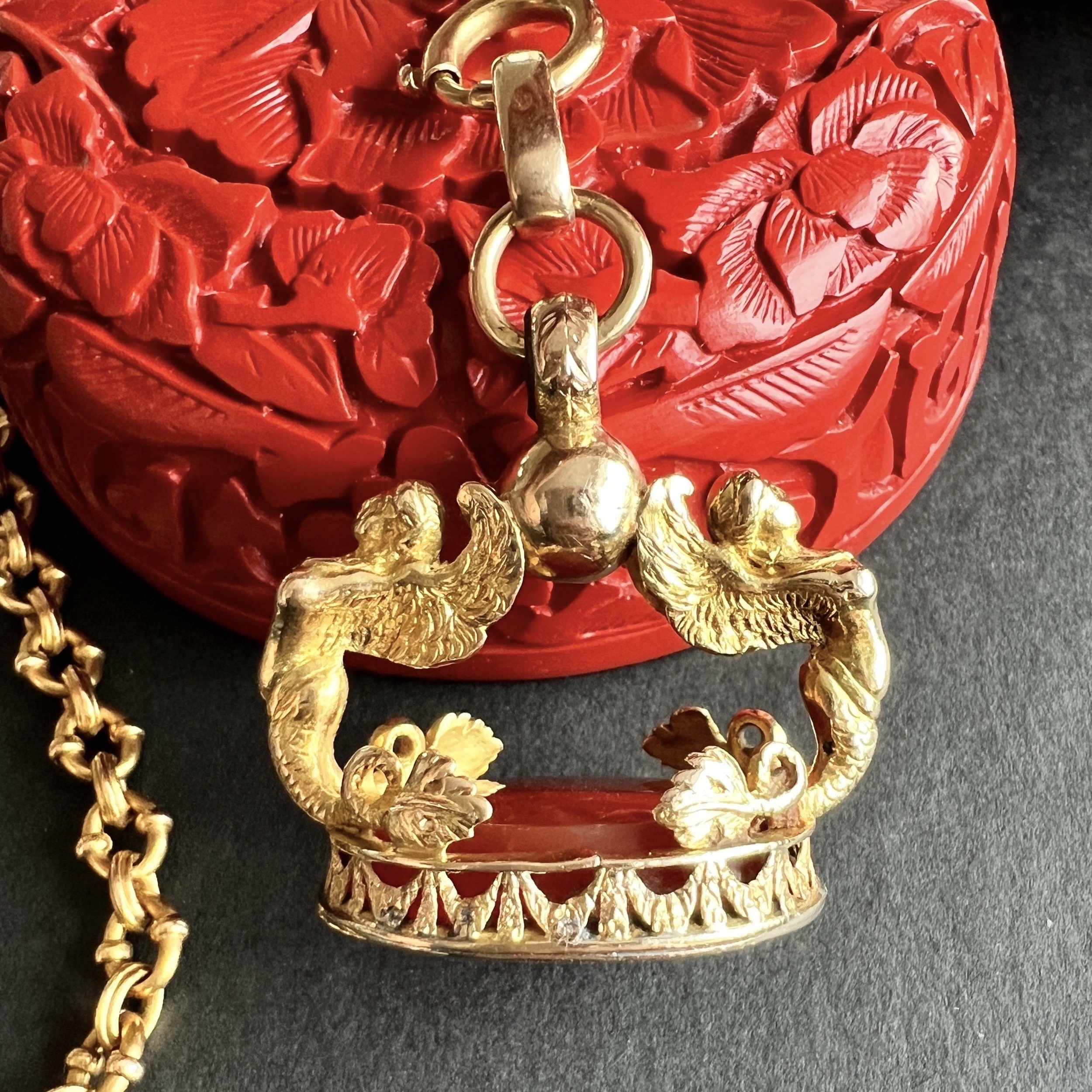
- Antique French Early 19th Century Gold and Carnelian Seal Fob with Winged Sirens
Antique French Early 19th Century Gold and Carnelian Seal Fob with Winged Sirens
Antique French Early 19th Century Gold and Carnelian Seal Fob with Winged Sirens
Sirens and Heraldry
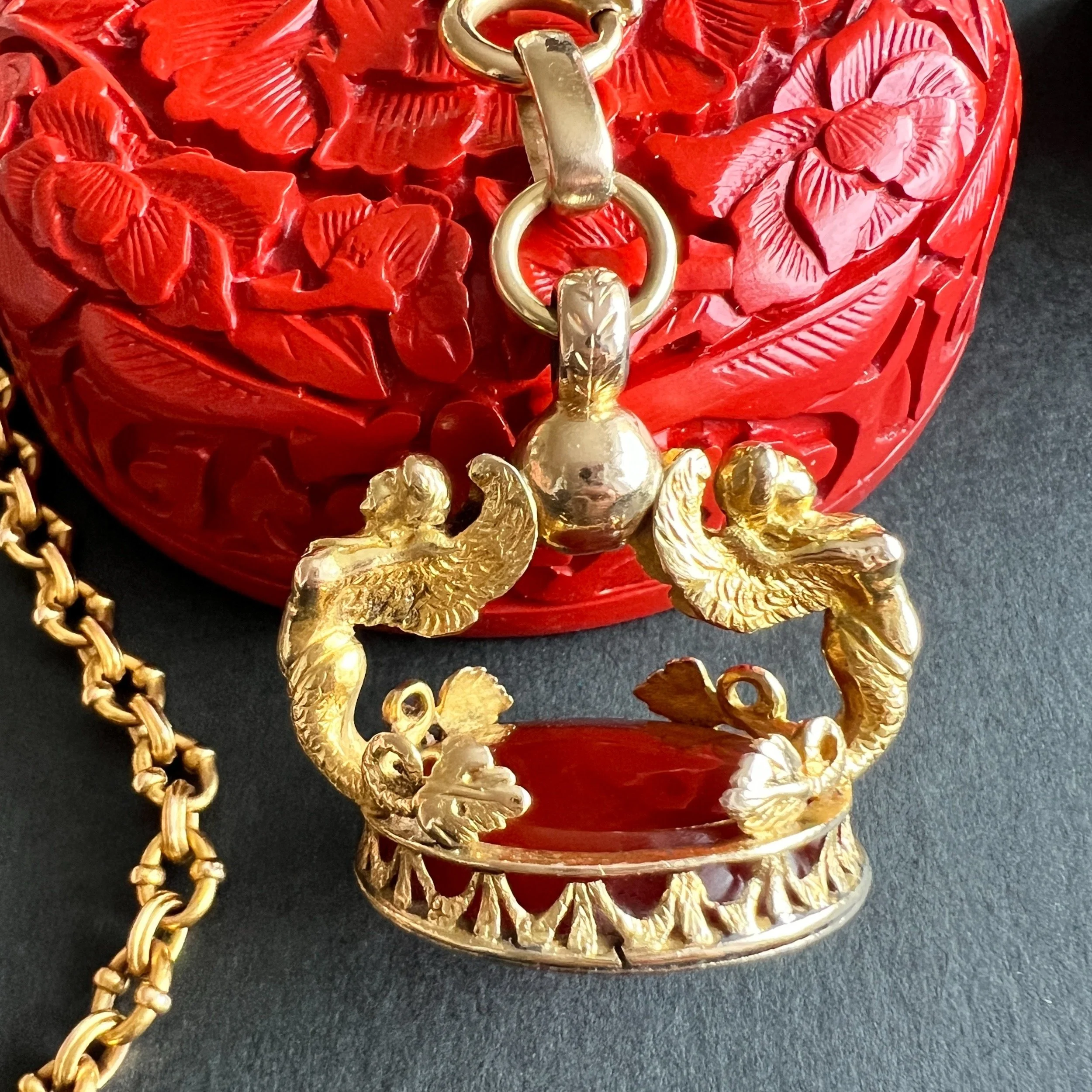
A matched pair of winged sirens rise from either side of this fob, lending it a graceful, architectural silhouette. Combining the faces and torsos of women with feathered wings and fish tails, these sirens reflect the enduring influence of classical mythology and the emerging Romantic imagination of the French Restoration.
In ancient Greek literature, sirens were dangerous creatures whose enchanting song lured sailors off course to their doom, most famously in Homer's Odyssey. By the early nineteenth century, they had become celebrated motifs of beauty, fantasy, and refinement in both Neoclassical and Romantic taste. Here, the sirens frame an exquisitely carved carnelian intaglio, creating a miniature work of sculpture and an emblem of identity.
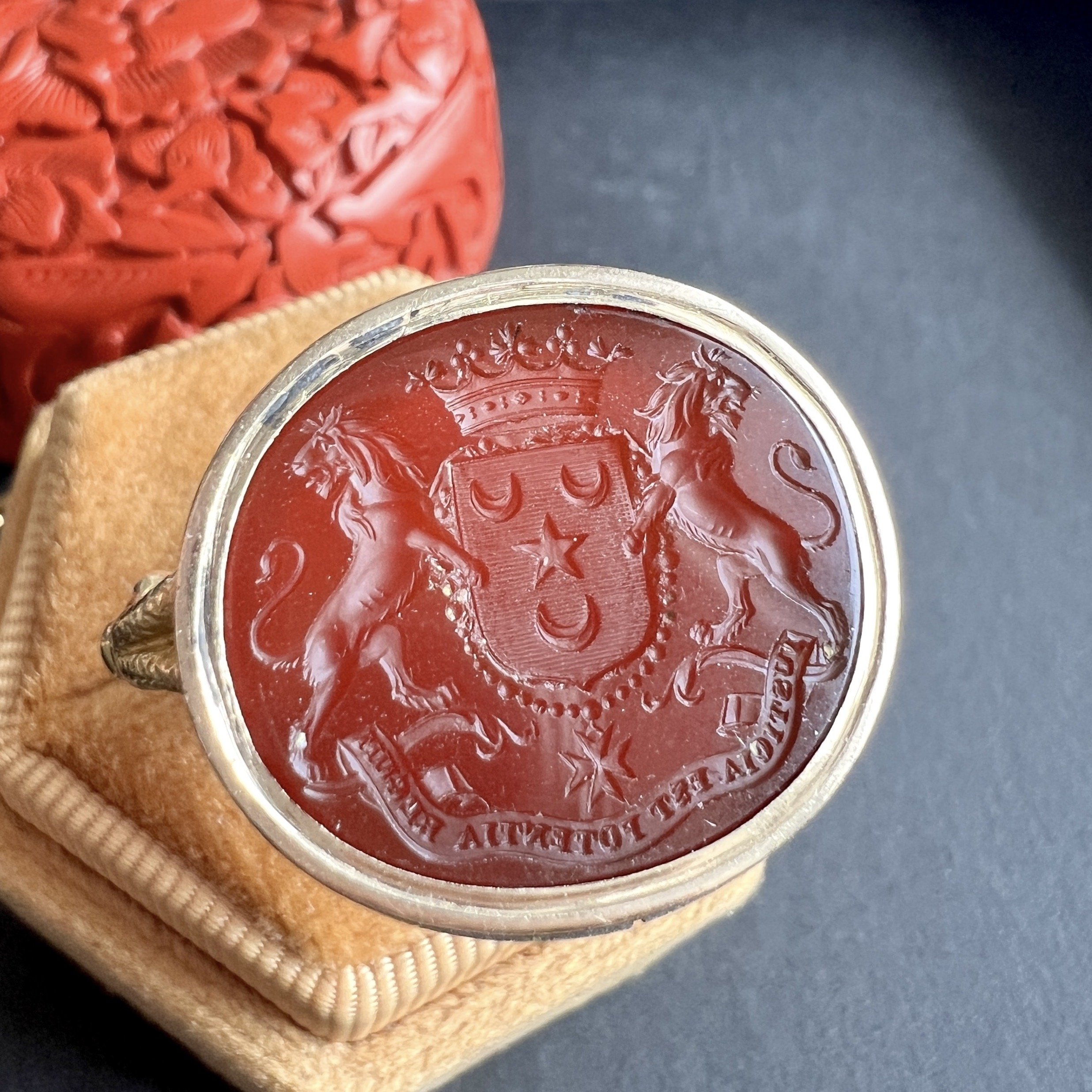
The intaglio bears the armorial achievement of the Camus de Pontcarré family, part of the French noblesse de robe, whose members held prominent judicial and administrative offices under the Ancien Régime. The arms feature a central star and three crescents beneath a count's coronet, flanked by two lions and encircled by the collar and cross of the Royal and Military Order of Saint Louis, established by Louis XIV in 1693 to recognize distinguished military service. Below appears the family's Latin motto: Justicia est Potentia Regum ("Justice is the Strength of Kings"). The message is unmistakably royalist, but the central idea remains timeless: a leader's true authority rests not in force or fear, but in the just exercise of power.
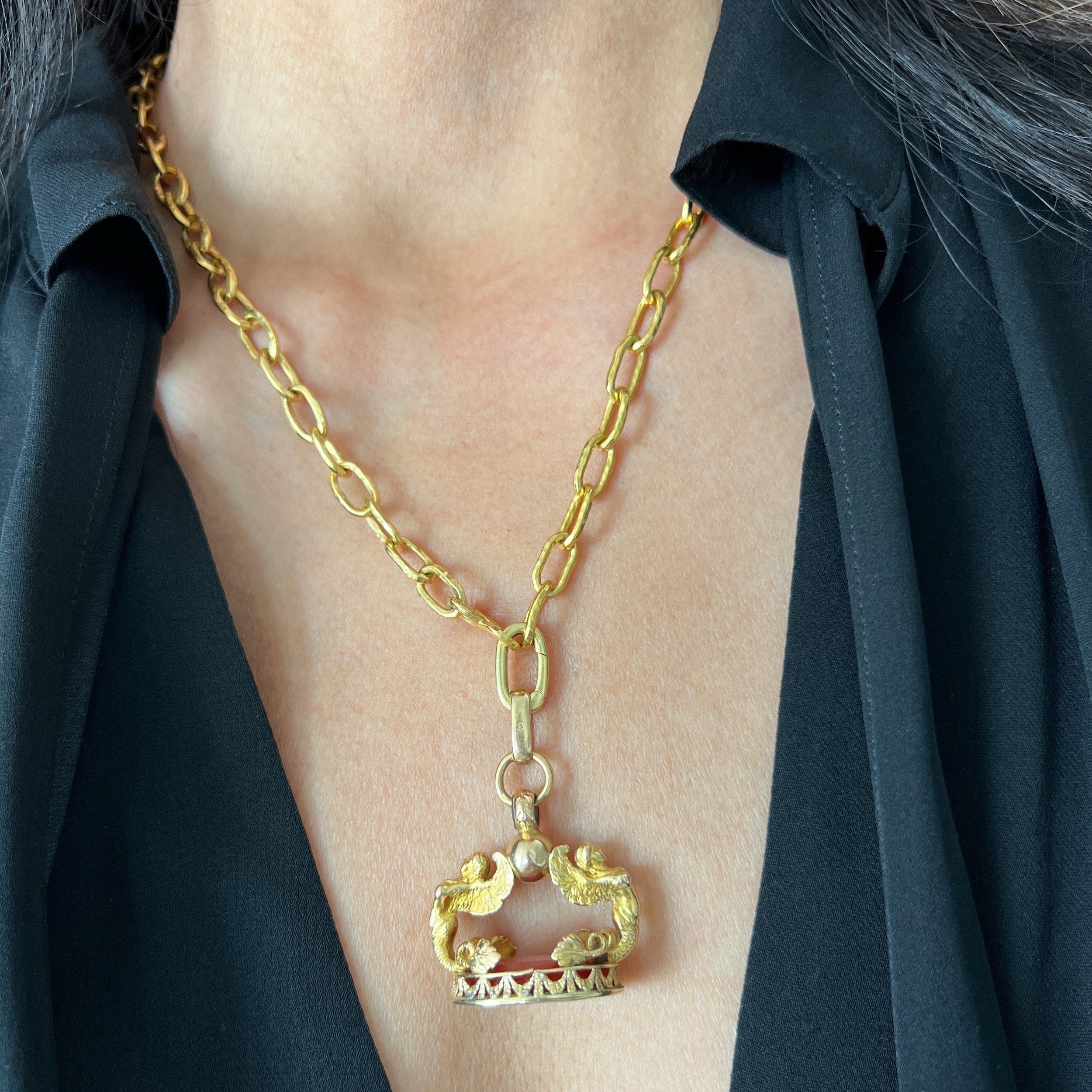
Created during the French Restoration, this fob remains a wearable connection to the worlds of Homer, monarchy, and heraldry. Today, we see it suspended from a French sautoir as part of a collector's wardrobe, inviting conversation and contemplation.
Marked with the French owl and a partial poinçon that appears consistent with the French coquille Saint-Jacques shell, both of which would have been added at a later date. We nevertheless believe the piece to be French in origin based on its design, heraldic seal, association with the Camus de Pontcarré family, and provenance in France.
18k at the top loop (likely a later addition), 14k at the bezel, and the remainder testing between these finenesses. Such variation is not uncommon in functional antique jewelry requiring durability as well as beauty, such as seal fobs. The stone is carnelian.
Dimensions and weight:
● 45.4 mm long (including the bail)
● 31.4 mm wide
● 22 mm deep
● 15.4 grams
Period: Early 19th Century/French Restoration/Late Georgian
*Please note that all dimensions and weights are approximate. Age-commensurate wear may be present. The inside of the top loop contains an old reinforcement.
Sirens and Heraldry
A matched pair of winged sirens rise from either side of this fob, lending it a graceful, architectural silhouette. Combining the faces and torsos of women with feathered wings and fish tails, these sirens reflect the enduring influence of classical mythology and the emerging Romantic imagination of the French Restoration.
In ancient Greek literature, sirens were dangerous creatures whose enchanting song lured sailors off course to their doom, most famously in Homer's Odyssey. By the early nineteenth century, they had become celebrated motifs of beauty, fantasy, and refinement in both Neoclassical and Romantic taste. Here, the sirens frame an exquisitely carved carnelian intaglio, creating a miniature work of sculpture and an emblem of identity.
The intaglio bears the armorial achievement of the Camus de Pontcarré family, part of the French noblesse de robe, whose members held prominent judicial and administrative offices under the Ancien Régime. The arms feature a central star and three crescents beneath a count's coronet, flanked by two lions and encircled by the collar and cross of the Royal and Military Order of Saint Louis, established by Louis XIV in 1693 to recognize distinguished military service. Below appears the family's Latin motto: Justicia est Potentia Regum ("Justice is the Strength of Kings"). The message is unmistakably royalist, but the central idea remains timeless: a leader's true authority rests not in force or fear, but in the just exercise of power.
Created during the French Restoration, this fob remains a wearable connection to the worlds of Homer, monarchy, and heraldry. Today, we see it suspended from a French sautoir as part of a collector's wardrobe, inviting conversation and contemplation.
Marked with the French owl and a partial poinçon that appears consistent with the French coquille Saint-Jacques shell, both of which would have been added at a later date. We nevertheless believe the piece to be French in origin based on its design, heraldic seal, association with the Camus de Pontcarré family, and provenance in France.
18k at the top loop (likely a later addition), 14k at the bezel, and the remainder testing between these finenesses. Such variation is not uncommon in functional antique jewelry requiring durability as well as beauty, such as seal fobs. The stone is carnelian.
Dimensions and weight:
● 45.4 mm long (including the bail)
● 31.4 mm wide
● 22 mm deep
● 15.4 grams
Period: Early 19th Century/French Restoration/Late Georgian
*Please note that all dimensions and weights are approximate. Age-commensurate wear may be present. The inside of the top loop contains an old reinforcement.